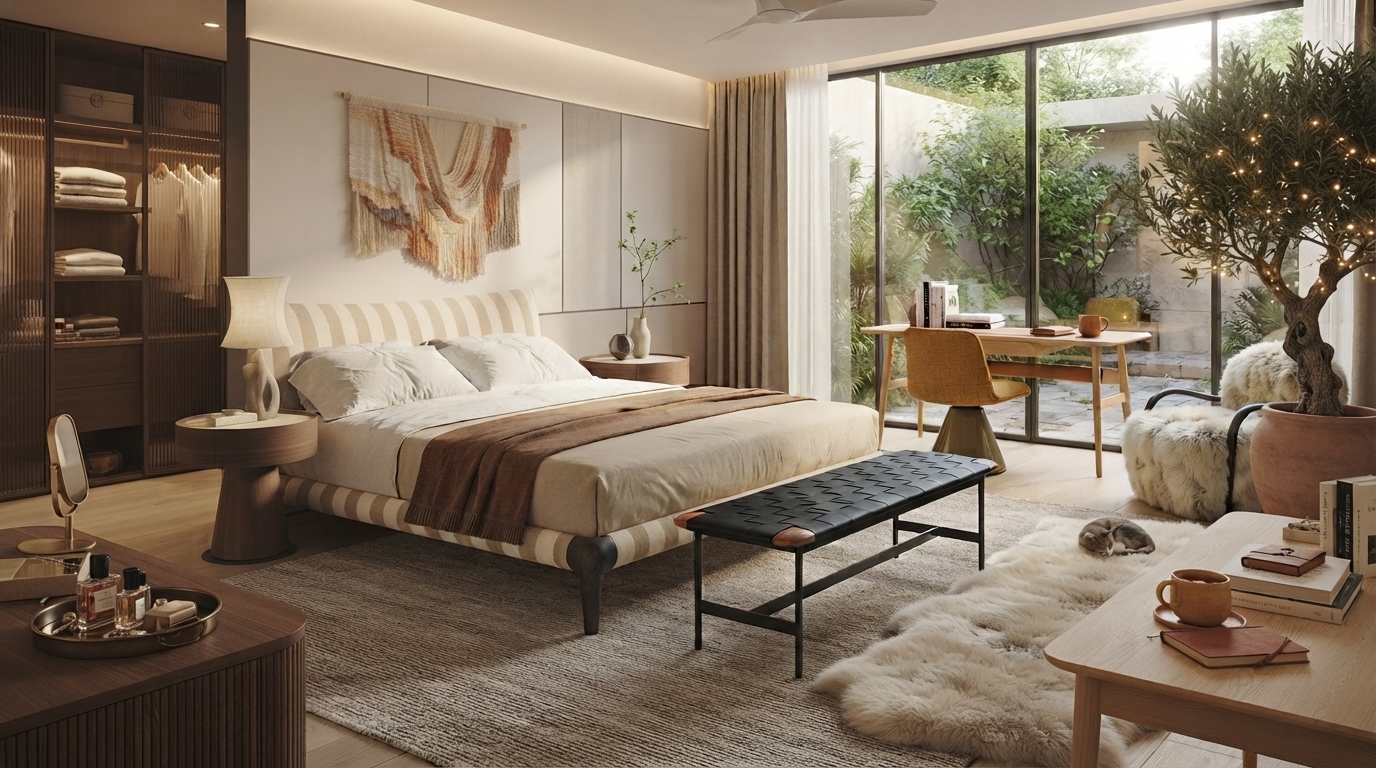
What is the Mid-century Modern Style furniture? Please refer to the introduction of medieval style home decoration.

The visual feature of Mid-century Modern style lies in "Juxtaposition", which can be bluntly and appropriately extended to "juxtaposition" and "contrast". The word is first intuitively reflected in the color, with earth colors, raw wood colors and their natural texture to set the tone, and then with a lively, highly saturated color block bold color contrast. In general, most people give a sense of warmth, fun without losing poise.
Classic colors include orange-red, avocado green, coral/berry red, bright yellow and royal blue. These colors can be added as jumping embellishments (small decorative pieces), and can also be used as large color blocks (large area fabric, large area paint, large furniture).
The original wood color as the keynote is also dominated by high saturation and warm tones, such as honey-colored teak and red-brown oak, which are not only widely used for paving, but also for walls, cabinets, suspended ceilings, door panels and so on.
The appropriate use of black and white gray to adjust the warm color and excessive saturation caused by the swelling.

2. Material for Mid-century Modern Style furniture.
Another very important juxtaposition is in the use of materials - to show the interface between natural tradition and modern industry in a neutral and peaceful manner.
On the one hand, the development of industrial productivity and the new technology and material heat driven by the space race after World War II made new non-traditional materials (including glass fiber, resin, etc.) begin to be used in furniture; On the other hand, the use of natural materials and architectural style complement each other - inspired by Frank Lloyd Wright's prairie architecture and organic architectural aesthetics, MCM style architecture uses natural materials such as stone and brick, exposing wooden beams to allow the house to blend with nature. These facades are partially extended into the interior: wood, stone, and brick serve as feature walls, which are combined with (fake) fireplaces. In the soft outfit, animal leather and plush material form a soft and nostalgic part, sometimes there will be rattan, a small range of seats, cabinet doors and other vertical faces, mixed with a cool atmosphere.
If you want to imitate the Mid-century Modern Style furniture, you must also make good use of metal, glass, mirrors, which are very representative of modern elements - furniture with metal rods, glass coffee tables, metal lamps, and so on. Compared with the emergence of materials themselves, the most important thing is that they are full of modernity "juxtaposition" -- different material characteristics and visual effects are presented based on different functional needs, which are not deliberately reconciled, but are simultaneously juxtaposed in a neutral way, and the richness of experience is simmered in the collision.
MCM style is more advocating the modern glossy gold and silver of the metal itself, or the industrial rich black spray, relatively less classical dark gold; Furniture rods are mainly silver, black metal or logs, and gold mainly appears in lights, clocks and other furnishings.
As far as glass is concerned, special glass such as colored glass (brown, brown), embossed glass (chequered glass, long rainbow glass) is often quietly brewing surprises. In addition, glass bricks, as a new material that has been widely used since the 1930s, also feature the style of The Times.
Compared with prairie style, MCM style houses have higher ceilings and larger Windows, allowing for a sweeping view of green life outside; If the residence does not have such vegetation-rich environmental conditions, more attention should be paid to the introduction of natural breath indoors, green plants are essential. Through more personal observation and finishing, Mid-century Modern style interior design prefers to use the following indoor plants -
Foliage green plant: turtle back bamboo, rubber tree, tiger orchid, cactus, Qin leaf FIG, loose tail sunflower, horsetail iron;
Fresh cut flowers: tulips, lilies, calla lilies, flamingo flowers, gerbera (more use of single flowers with prominent patterns).

3. Geometric figures and lines in the open space for Mid-century Modern Style furniture.
MCM style is based on the open pattern of interior space, fully respect the "free plane" of modernist architecture, only transparent sliding doors, cabinets (especially hollow custom modeling cabinets) in the large plane to do partial partition; The way the home is placed is full of cubism and the imagination of "shallow space", in popular terms, that is, the boundary between the fuzzy plane and the three-dimensional perception, the depth of the fuzzy distance.
In the middle of the last century, influenced by World War II and political changes, European designers, especially many German designers deeply influenced by the Bauhaus, moved to the United States and became the main force promoting the Mid-century Modern Style Movement. They abandoned complex classical decoration, advocated simple lines and functionalism, and gradually rose to the ultimate rationality of purism and constructivism. The furniture works designed have smooth Outlines, mostly the combination of basic geometric figures and lines.
The spherical lamp jumps out of the space outlined by the lines, like a circle on the flat painting sketched by the squares, forming a contrast.
The most important thing is that the space is matched with a variety of classic designer chairs, and through the color and material to distinguish from the main sofa. There were too many classic seat designs in the heyday of MCM. They all pay attention to the smooth outline, pay attention to the contrast between materials, lines and blocks, pay attention to ergonomics, and are full of the avant-garde of that era like space capsules. Among the most famous and widely copied players are Arne Jacobsen's Swan Chair and egg Chair, Mies' Barcelona Chair, and the Eames Chair (also known as the Eiffel Chair) designed by the Eames couple, and so on. Investing in a classic chair is like placing a durable installation in a space.
The design of lamps is another area that embodies the unique inspiration of designers in the middle of the last century. The shape of the lamp is mostly based on the evolution of basic geometric shapes, and the materials are mainly mirror metal, colored resin and glass. As mentioned earlier, the space race and space fever made the futuristic, space-like design language a feature of the 1960s, and the highly featured spherical lights, satellite lights, and UFO lights were suspended in space without any support - whether as central and radial full-bodied individuals, or arranged into decentralized combination lights and string lights. Both have taken into account their own effect as a graphic complement in the flat facade.
If you tend to a more stable environmental atmosphere, the lamps that constitute the Mid-century modern style can also be pure and rustic: the floor lamps and desk lamps choose clean white cylindrical lampshades, which will not overwhelm and do not bring redundant information.
Carpet: MCM style Spaces tend to use large solid color carpets, mostly in soft gray, beige to neutralize the space's high saturation and overly warm tones. In cases where there is a clear main color overall, or there are not many other colors, using the previously mentioned colors (deep red, olive green, lemon yellow, navy blue) as a base or contrast color is also a challenging but expressive choice.
The coffee table, the dining table, adhering to the basic principles of "modernism", the simple combination of a pure panel and a few thin legs is perfectly appropriate - the glass panel is modern and light, and the wood and rock panels are more classical and calm.
However, when other homes in the same space are relatively simple and lack highlights, and therefore need to supplement the surprise of the sense of modeling, you can choose a sculptural, or a foot full of lines. Their shapes tend to be abstract and fluid.
In the rest of the furniture selection, the thin leg furniture can be more vivid into the Mid-century Modern Style furniture, especially a thin leg warm wood grain low side cabinet, practical at the same time to guide the center of a decorative area - with ornaments, green plants and hanging pictures, etc.

The horizontal lines of the wooden bottom plate are emphasized to make the cabinet disappear and become the background wall directly. Among the other ornaments, the Mid-century Modern style clock stands out, reflecting the collision of wood and metal, the interweaving of lines and geometric shapes. The most representative is the radial "starburst clock", which is similar to the satellite light design language.
The choice of hanging paintings, compared with realistic and delicate, classical and romantic paintings, gives priority to abstract styles that highlight lines and geometric blocks - neoplastic, Cubist paintings, etc., or jump, bold Dada, Fauvism and even pop works - styles that flourish in similar eras are always more bloodline.
All the decorations, whether hanging pictures, vases or others, pay attention to simple and smooth geometric shapes, bold colors, rich modern materials.
Perhaps now anyone can follow the above principles of color, material, geometry and line to integrate MCM style; Or use the safest and easiest method, such as directly choosing classic designer works of the same style, and directly buying second-hand items from the middle of the last century.

Everyone says that fashion fades and style lasts, but in fact it is more important for everyone to ask themselves in what way they will experience the style they have built so deeply, and truly relate to and interact with the space and the aesthetics within it - styles that ignore their own individual thinking and only exist on the surface will eventually lose their meaning.
Welcome to visit our homepage //www.teemliving.com/home/product.html. to learn more for the Mid-century Modern Style furniture.